Commercial & Office Movers in Watertown, NY
Watertown Movers moves businesses around the Watertown area: offices, professional practices, shops and warehouses. A good business move is timed for when you're closed, not pushed through a busy week, and ordered so the things you need to keep trading leave last and arrive first. Share both addresses, a rough headcount and the date you must be up and running, and ask any mover to plan the sequence with you on that basis.
Businesses that move
Offices and professional firms
Law, accounting, finance, agencies, consultants.
Doctors, dentists and vet clinics
Machines and paperwork each need their own kind of care.
Shops and storefronts
Fixtures, stock, display units and checkout gear.
Warehouses and workshops
Racking, inventory, benches and machinery.
Restaurants and food service
Appliances, prep tables, shelving and stock, moved around service times instead of during them.
Schools, churches and community groups
Lecture rooms, corridors, offices and supply stores, fitted around a semester gap or quiet week.
A single team, one level, or a shuffle inside the same building
Clearing two floors and refilling them while new carpet is laid.
Server closets, computers and stored archives
Within a bigger move or as a job of their own.
Moving a family home instead of a business? See residential moving, which is planned in a different way.
Lost trading time costs most
In a business move the truck is seldom the big expense. What costs most is the stretch when your business can't operate, and a sound commercial move is planned around keeping that short.
That calls for careful ordering more than speed. Start by naming the functions you can't run without; they move last, so they're down for the shortest possible time. Computers and networking are usually the final things out of the old site and the first set up at the new one. Teams that can work remotely for a day go early. Bigger firms often move in stages over several trips instead of in one push, which adds a few runs but saves far more in lost business.
That order doesn't appear by chance on the day; it comes from walking through both sites ahead of time.
Jobs to finish before moving day
When an office move fails, the cause is almost always planning, not the heavy lifting:
Have phones and internet working at the new site before the move, not after it.
Setting up service at a new commercial address often takes far longer than people expect, and it's the top reason a business gets everything moved yet still can't open on Monday. Place the order the same week the lease is signed.
A numbered layout of the new premises.
Each desk, office and storage spot marked, so no one stands in a hallway deciding while others wait.
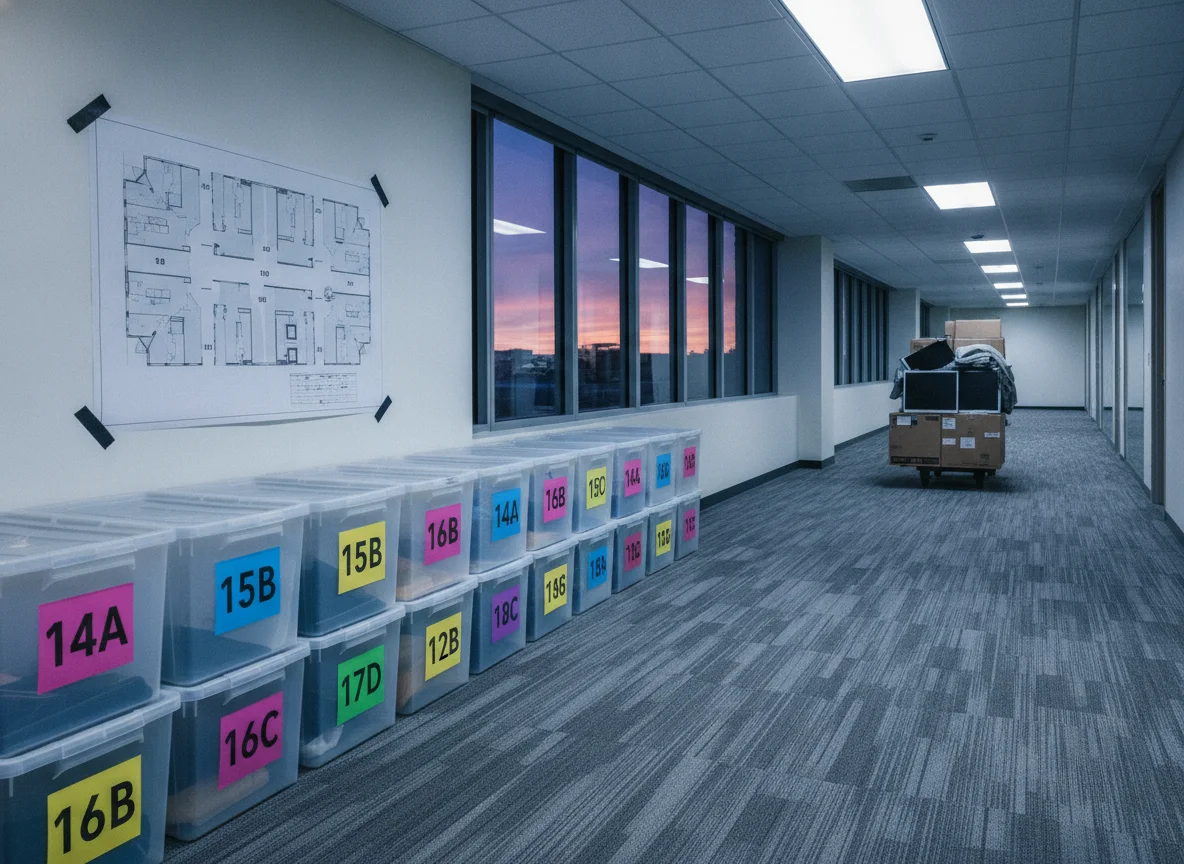
One labeling scheme for all.
Give each destination room a number or color, put that mark on every box and piece of furniture, and post a matching floor plan on the wall at the new premises.
A named contact at both sites.
A decision-maker who can field questions at the current address and at the new address too.
Employees box up their own desks.
Each person gets one crate marked with their name and new desk number, and takes personal items and valuables home instead of packing them. It's quicker, it costs less, and everyone finds their own things.
Building access written down.
Who unlocks, who locks up, alarm codes, keys, parking, and any limits on when work can happen in the building.
Contact both landlords in advance.
Many buildings ask for notice and paperwork from the moving company before anyone may start work. Find out what they need well before the date, since it's slow to sort out in the final week.
Computers, machines and items with special rules
Run a full backup before unplugging anything.
Any move carries a small risk of data loss, and a current backup makes that risk beside the point.
Take photos of the rack rear and the back of every workstation
Do it before any cable is pulled. A few minutes of pictures saves hours later.
Cables unplugged, bagged and tagged to the device they came from
Never tossed into a shared box. Monitors ride upright in fitted cartons, and towers are boxed, not loose.
Servers and networking gear are shut down and restarted by your IT provider or a specialist firm
They know how to power things off cleanly and bring them back up in order. Movers carry the hardware; setting it up again is IT work, not part of the moving job.
Check the agreement on any copier or printer before anyone moves it.
Leased machines frequently must be moved by the leasing firm's own technician, and moving one yourself can break the contract or cancel the service plan. Arrange that on its own, and early.
Vaults, fire-resistant files and heavy machinery
These need proper equipment and enough hands, and sometimes a check of how much weight the new floor can bear. Mention them at the start, not the end.
Medical, dental, lab, kitchen or gym equipment with maker's rules
Such gear often comes with manufacturer or vendor instructions for disconnecting, moving and recalibrating it. Where those apply, the vendor's technicians handle that part.
Cubicles, desks and office furniture
Cubicle and panel systems can be taken down and rebuilt, but they're not interchangeable. Panels, connectors and hardware belong to one specific system, and a layout that suited the old office won't always fit the new floor plan. Before assuming everything transfers, confirm which system you own and what the new space can accommodate.
Sit-stand desks, boardroom tables, filing systems and racking also come apart and go back together. Each time, the hardware stays bagged and attached to the piece it came from, since a partition panel without its connectors is junk.
Files and sensitive records
Client files, HR records, and medical or financial papers should move sealed, numbered and checked off at both ends, so nothing sits unattended and nothing turns up unaccounted for. If rules govern how your records are handled, put those rules to any mover during planning and ask how they'll be followed; that belongs in the planning stage, not on moving day.
Anything that shouldn't leave the building in a stranger's hands should travel with one of your own staff.
Returning the current space as the lease demands
Commercial leases usually require the space returned in a set condition, a duty that's easy to forget until the last week. Bolted shelving, wall brackets, signs and cabling often must be removed, and old furniture and dead IT gear need somewhere to go. The Jefferson County Recycling & Waste Management Department recycling center serves businesses that hold a Commercial Waste Permit.
Bring it up while you're planning. With notice it's simple; in a rush it gets costly.
What drives the cost
The volume of furniture, files and stock, how much needs taking apart and rebuilding, how much IT and specialty gear is involved, how easy each building is to load and unload, whether it's done in one trip or several, whether the work happens during or outside trading time, and how much of the old space needs clearing and disposing of afterward. For tasks you'd rather keep in-house, loading and unloading help supplies the lifting while your staff run the rest.
Business moves across the Watertown area: East Watertown, Huntingtonville, Black River, Sackets Harbor, Adams, Carthage, and the towns around them.
Business move questions
Can we stay open while moving?
Often, yes. Phased moves, and moves timed around your trading times, exist so a business needn't close. They take more planning and sometimes extra trips, and they usually pay for themselves.
Who unplugs and sets up the PCs?
Your IT provider or a specialist takes care of shutdown, networking and restarting everything. Movers deal with the physical equipment. Make sure each side knows its part before the day, since "I thought you had it" is how a business loses a whole morning.
How early should we begin planning?
Sooner than for a house move, and the timeline is set by internet setup, landlord paperwork and vendor-handled equipment, not the truck. Start those once the address is firm; NOAA normal snowfall here tops 116 inches, so leave slack in winter.
Can packing be included too?
It can: packing services range from a full pack to only the parts you'd rather staff didn't do, like a records room or kitchen. Most firms have employees box their own desks and hand off the rest.
Starting the plan
Share both addresses, a rough count of people and workstations, your target date and anything unusual: servers, a safe, lab gear, a leased copier. The New York State Department of Transportation suggests comparing at least three estimates.