Long Distance Movers in Watertown, NY
Watertown Movers takes on moves that leave the Watertown area for another state or the far side of the country, be it a family home, an apartment, or a small office. A proper long-haul job lists every piece, pads it, loads it and carries it to the new door, crating anything fragile or awkward. Tell us where you're leaving from, where you're headed and roughly how much is coming.
When a move counts as long distance
Any move that crosses a state line, or one so far that loading and delivery can't share a day. In New York the split is exact: the New York State Department of Transportation covers only moves that begin and end inside the state, and anything crossing the border falls under federal rules. That sets it apart from a local move: you plan around a delivery window, your shipment is recorded far more carefully, and you gain specific rights worth using.
The rest of this page shows how to make that work for you.
The question on every mind: when does the truck show up?
On an interstate shipment you're given a delivery spread, meaning a span of possible dates instead of one fixed day. That's standard practice, not evasion. A truck covering two thousand miles works around weather, required driver rest and other customers' goods in the trailer, so a precise hour that far out is a promise nobody controls.
The spread should be explained to you before you sign, not once your belongings are already rolling. Ask how many days it covers, what happens when it runs over, and how you'll hear about progress while the load is on the road. Goods sharing a consolidated trailer with other households tend to get a broader spread than a dedicated load, and that trade-off deserves thought before you pick a mover.
What follows is the step almost everyone forgets: plan on staying in the new home with none of your furniture for every day of that spread. There's more on this further down.
What shapes the cost
A cross-country quote rests on other factors than a local one does:
The weight you ship.
The largest single factor, and the one most within your control. Anything you leave behind is weight that never lands on the bill.
Distance and destination.
Miles matter, but so does the route: a drop-off on a busy interstate corridor is a different job from a rural address far from the highway.
Steps and long carries.
At the pickup and the drop-off.
How much of the packing you hand over.
Details on packing services.
The calendar.
Moving demand peaks in summer and at the end of each month, so booking further out pays off then.
Add-ons.
Custom crates for glass, stone or artwork, a storage stop between pickup and delivery, added stops, and car shipping.
Getting the truck in.
When a full-length trailer can't reach an address, legally or physically, because of a narrow street, low branches or a bridge, a sharp corner, a steep or gravel drive, or a weight-limited road, the load moves onto a smaller truck to finish. Movers call that a shuttle, and it's a common surprise on delivery day. In Watertown, where NOAA normals put yearly snowfall above 116 inches, a winter driveway can be the obstacle. Raise it while quotes are coming in.
What to ask every interstate mover you call
Nothing on this page protects you more than these questions. Put each one to us and to every other firm on your list:
Will you haul it, or broker it?
A broker passes your move on to a carrier you've never met or checked out. Both are legal business models, but find out which you're dealing with before any deposit changes hands.
Can I see your USDOT number?
Interstate household goods movers are each issued one. Look it up with the Federal Motor Carrier Safety Administration to see the authority and complaint record behind it.
Is the quote binding, capped at a maximum, or non-binding?
Each type reacts differently if the load weighs more on the scale than predicted. Have the answer put in writing.
Does anyone look over the house first, live or on video?
A figure worked out without anyone seeing the goods is guesswork, and guesswork tends to change once loading starts.
How wide is the arrival window, and what if it runs late?
Long-haul delivery is set as a range of days, not a single date, and that range is written into the contract. Find out its width, the day it begins, and what the mover does if it lapses.
Are other households' goods riding in the same trailer?
On long hauls they usually are, and there's nothing suspicious in that. It still matters, because a shared load is exactly why you get a span of days instead of one date.
Might a smaller truck be required at one end?
Raise it before you settle on a quote. If either street can't take a full-length trailer, the goods get moved across to a smaller truck, and learning that early beats finding out with the truck parked outside your door.
How large is the deposit?
A reasonable deposit is normal. A big demand for cash up front, or a push to pay before the terms are written down, deserves a second look.
How are my belongings covered by default, and what would an upgrade add?
Default cover on an interstate move is thinner than most expect. Ask how it's worked out, and read the Your Rights and Responsibilities booklet movers must give you.
Preparing goods for a long haul
A cross-country move is no quick drive. It means days of road vibration, a trailer that may be loaded and unloaded more than once, and other customers' goods packed in beside yours. Preparation changes to match:
Each item gets listed, with its condition noted, before loading begins
That way what left your old home can be matched to what reaches the new one. Compare the list with what you actually see on delivery, before you sign.
Pads go on, then get taped or strapped down.
A loose blanket that slides off in the first hour on the highway has done nothing for the rest of the journey.
Crates for marble, mirrors, glass, stone and artwork
Wrapping alone won't do. A stone top is weak across its face and can't take days of vibration while lying flat.
Mattress cartons rather than plastic bags
For the long haul. A bag is fine across town but does nothing against a week of rubbing in transit.
A straight answer on flat-pack pieces.
Particleboard furniture that has been taken apart before rarely justifies its shipping weight over that distance, and it often turns up out of square. Better to hear that now than to load it and discover the problem at the other end.
Screens ship standing up
TVs go in fitted cartons, never flat with weight resting on the screen.
A load that won't shift
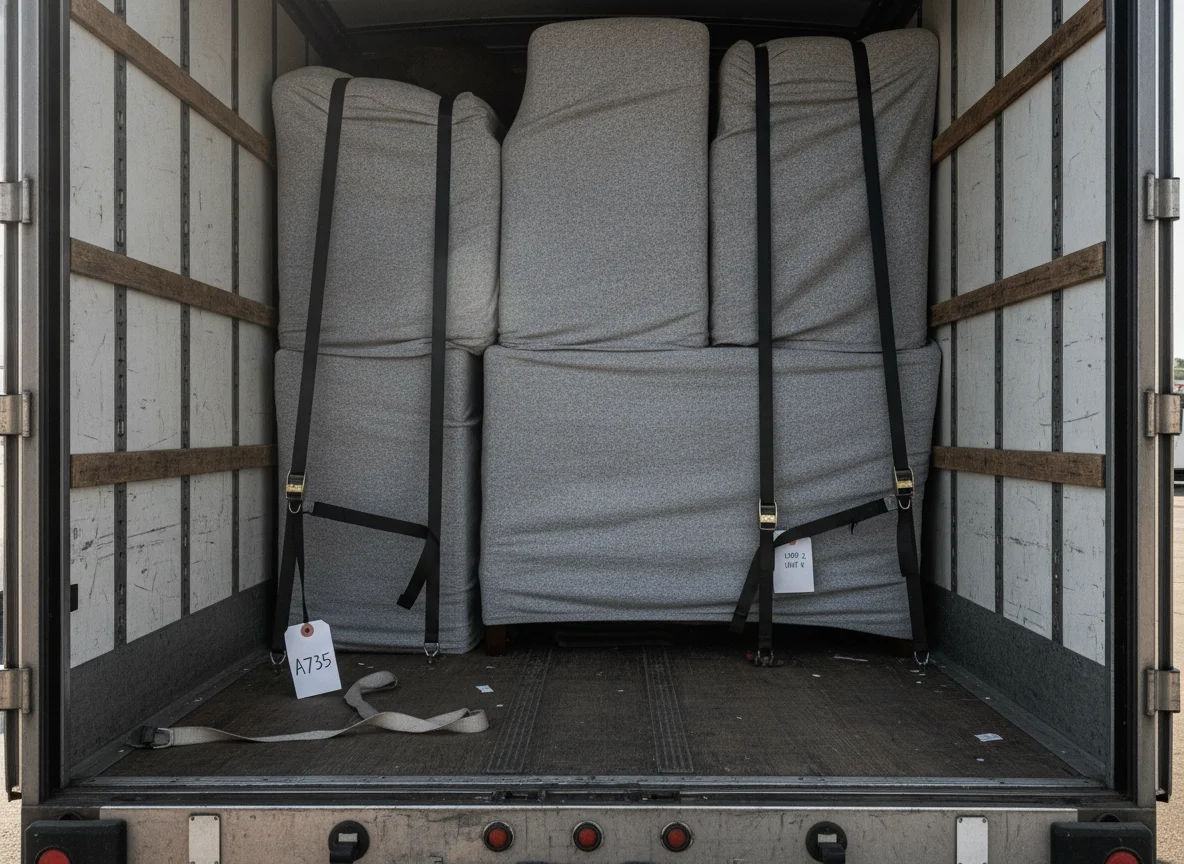
Heavy boxy pieces go low and along the walls, cartons get stacked and tied, and nothing is left loose to slide when the trailer corners at speed.
Items movers won't load
Anything that burns or corrodes
Gas cans, propane cylinders, paint thinner, spray cans, pool chemicals, ammunition and fireworks. Mowers and generators go only once drained, with the spark plug out.
Fresh or opened food
Goods riding a truck for days cannot stay chilled.
Houseplants.
Some states inspect or reject plants at their borders on agricultural grounds, and few survive days in a dark trailer anyway.
Animals.
They ride with you, never on the truck.
Anything you can't replace.
Papers, passports, prescriptions, jewelry, laptops, hard drives, keys and keepsakes belong in your own car. If losing something would wreck the whole move, keep it off the truck.
Prep work
Clear things out before packing, not after unloading. Over a long distance every box carries a cost, so the cheapest one is the box you never fill. Nothing else you do before moving day has such a direct effect on the bill.
Take photos of anything valuable before it gets wrapped, and write down serial numbers on electronics. An hour spent now keeps any later dispute over damage brief.
Pack for the in-between days. From loading to delivery you still have to live: clothing suited to the climate where you're going, prescriptions, chargers, work gear, school supplies, sheets, some basic cookware, and the moving paperwork. All of that rides in your car or your luggage, never on the truck. Skip this and you'll be repurchasing half your household.
Mark every carton with its destination room, and keep a list of your own beside the mover's.
Long-distance moves begin anywhere around Watertown: East Watertown, Huntingtonville, Black River, Sackets Harbor, Adams, Carthage and neighboring towns.
Questions people ask
How early should I reserve an interstate move?
Sooner than you would for a local job. Long hauls get slotted into a route instead of a single day, so the earlier you call, the more choice you have over the pickup date. Summer and the last days of any month are when demand peaks, so build extra lead time around those.
What about shipping my car?
Cars normally travel separately from household goods, on another truck and often on a different schedule. Mention it at the start of planning rather than at the end, because it shapes how you'll make your own way to the new home.
What if the truck arrives before the house is ready?
It happens a lot, and the answer is to store the load between pickup and delivery. Mention it the moment a gap looks possible: storage arranged in advance is simple, while storage sorted out on delivery day is anything but.
Is packing myself an option?
Yes, and many people do it to save money. Keep in mind that cartons you pack yourself can be treated differently from mover-packed ones when it comes to liability, so find out how that works before you choose which boxes to take on.
Planning the big move?
Tell us both addresses, your rough timing, the number of bedrooms, and any oversized or delicate pieces that need special handling. That's all we need to begin.