Local Movers in Watertown, NY
Watertown Movers handles household and small-office moves around the Watertown area. Furniture is padded and wrapped, broken down where it has to be, loaded, driven over, unloaded and rebuilt in whichever room you choose. A local move stays within New York, whether it's a few streets over or out to a nearby town. Tell us both addresses and your moving date to get things started.
Which job is yours?
Pick the one closest to yours:
An entire house or condo
All the rooms, along with basement, attic, garage and shed.
A rental unit
Census figures show 59% of households renting here; stairwells and shared entries are on the apartment moving page.
Just one room
A dorm-bound bedroom, a study, or a baby's room.
A shop or small workplace
Desks, file cabinets, shelves and computers, often after closing.
To or from a storage unit
At the start, the finish, or each.
A single bulky piece
A couch, a gun safe, an armoire or a treadmill. That counts as a furniture move, not a household one.
Room shuffles
Clearing two rooms and refilling them once new flooring is laid.
Heading to another state? Then long-distance moving is the right fit, quoted and scheduled on its own terms.
Keeping your home and things intact
Most damage during a move comes from a handful of predictable errors. This is how each is headed off:
Floors, door frames and stair rails are protected before lifting starts.
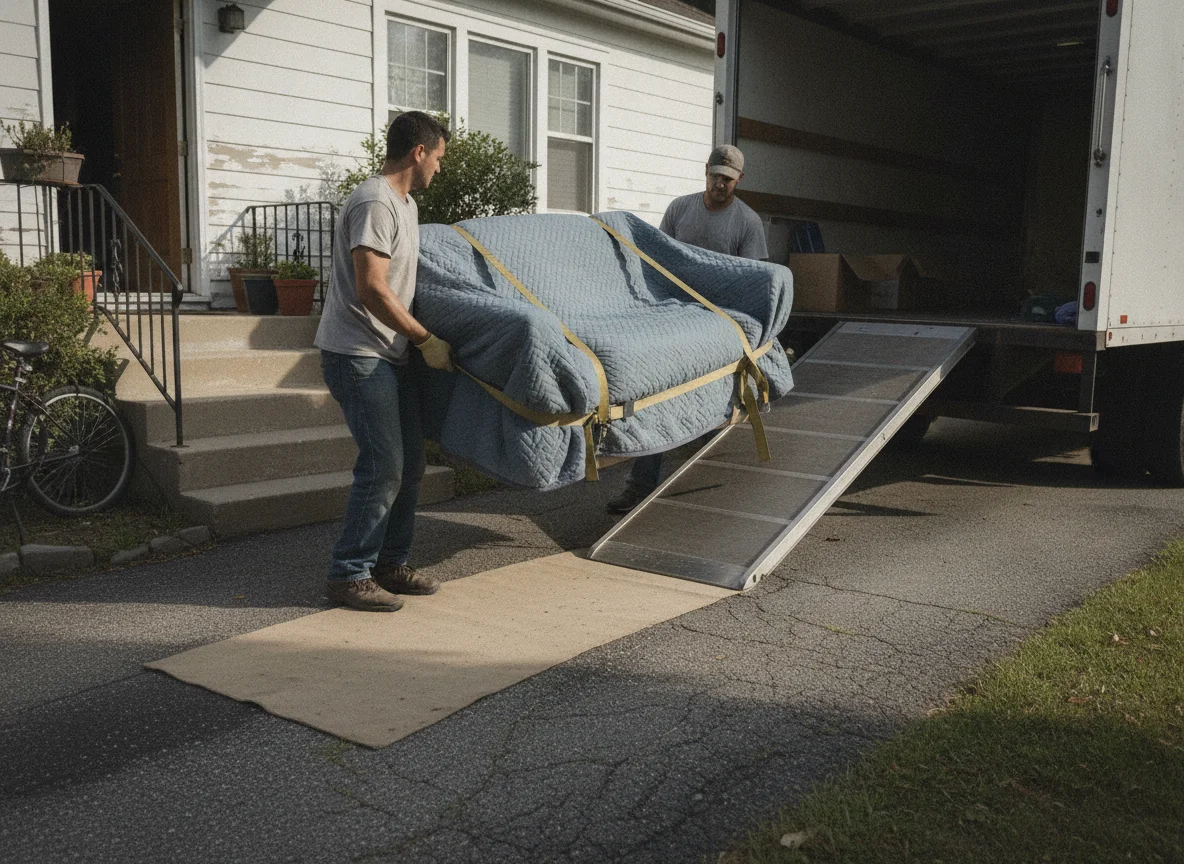
Runners go down on carpets and walkways, pads on door jambs, wrap on banisters. A move usually harms the building more than the furniture.
Upholstered pieces are wrapped in pads, never just piled.
Pads first, then secured, then onto the truck, since a couch picks up scuffs on its arms.
Flat-pack pieces stay in one piece if the doorway allows.
Particleboard rarely survives being taken apart twice. Cam locks and dowel holes wear out the first time, and a wardrobe broken down once often never stands quite square afterward.
Glass and stone tabletops ride standing up in a frame.
Stone is weak across its broad face, so a slab carried lying flat can split under its own weight at the first jolt.
Fold-out couches get the mechanism strapped before tilting.
Left unstrapped, it can swing out mid-doorway and catch the frame, the door casing, or somebody's leg.
Large items are measured at the bottom, not stuck partway up a staircase.
A piece that suits the room may still jam on a turning landing, and it's best to learn that early.
Mattresses get bagged.
Drag an unprotected mattress past a stairwell wall or rest it on a driveway, and it picks up stains for good.
Washing machines get re-bolted.
The drum is suspended on springs, and unbolted it bangs against its casing all the way there. Water supply and drain hoses, plus the refrigerator's ice-maker line, are unhooked and emptied so no water ends up in the load.
Televisions stand up in a fitted box.
Carry it upright, and keep anything from resting on it.
At the new place, cartons come off by the room on their label, and beds and tables are reassembled before anyone heads off.
What drives the cost
Two houses with the same furniture can turn out to be very different jobs, and the volume of stuff is seldom why. The main factors:
How easy each address is to reach. That covers the gap between your door and where a truck can park: steps at either home, a long path to the curb, a tight lane, a steep or soft driveway, a narrow gate, or cars lining the street. By Census count about 28% of Watertown homes sit in two- to four-unit buildings, so upstairs flats are common. Each obstacle repeats on every trip.
How much needs taking apart. Beds, tables, shelves, and anything too big to clear a door in one piece.
How much packing is already done. Sealed, labeled boxes waiting by the door make for a very different day than a kitchen nobody has wrapped yet.
The date. The end of the month and the summer weeks fill first, since that's when most people move.
A mover pricing a home properly needs to see it, in person or by video. The New York State Department of Transportation suggests at least three estimates, ideally after an in-home look. Be wary of a phone figure from someone who has not seen the place.
Details to gather before you reach out
No paperwork needed, only:
The two addresses and the floor at each one
Your moving date and any wiggle room
A rough idea of the load; the bedroom count usually does it
Bulky, delicate or tricky pieces, such as a piano, gun safe, pool table, big fish tank or marble tabletop
If you'd like packing services or plan to box things up yourself
With that, the job can be sized.
Tight timeline? Ask rather than assume; see same-day moving for short-notice moves.
Contact UsWhen a full move is more than you need
A frank word, since it can keep costs down:
A ground-floor studio or one-bedroom, nothing to take apart, and a rental truck or container already parked at your place?
Then loading and unloading help is the better fit: you keep the truck, and a crew loads it so the contents stay put on the road.
Just some boxes, no furniture?
Hauling that away is a different trade, and the two should not be blurred.
Items that never ride on a moving truck
Gasoline, propane cylinders, paint thinner, spray cans, pool chemicals, ammunition and fireworks stay off a moving truck. Lawn mowers, generators and trimmers can go only after the fuel is emptied and the spark plug removed.
Appliances on gas lines or hardwired
Have a qualified gas fitter or electrician disconnect and reconnect them. Movers carry the appliance but leave the gas line and wiring alone.
Carry the things you can't replace.
Papers, prescriptions, jewelry, keys, laptops and keepsakes travel in your own vehicle, along with pets and, over any real distance, houseplants.
Before the truck arrives
Seal and tape every carton and mark it with the room it's headed to. Put books in small boxes, since a big one full of books is too heavy to lift safely. Take liquids and breakables out of drawers, defrost the freezer the night before, keep a parking spot clear, and shut kids and pets in one room. Bulky things you won't keep can go to the Jefferson County Recycling & Waste Management Department drop-off site, open to any county resident.
Local moves run all over Watertown: East Watertown and Huntingtonville, out to Black River, Sackets Harbor, Adams, Carthage and nearby towns.
Questions people ask
How early should I call?
Get in touch once your date is settled. The last week of any month and the summer stretch are the busiest periods and get booked first, so if your move lands in one of them, reach out well before you begin packing.
What if something breaks during the move?
Before signing with any mover, ask what protection covers your goods, how it's calculated and what an upgrade adds. A clear answer tells you a lot. Under NYSDOT rules for moves within the state, a mover has to answer a written damage claim within 30 days and settle it in writing within 120.
Should I be home on moving day?
Yes, or have someone you trust make the calls for you. Questions come up all day, such as which items load last, where a piece belongs in the new house, and what stays behind, and they're easier with you present.
What about pianos, safes and pool tables?
Mention them ahead of time, not on the morning. They call for particular equipment and enough hands, and a pool table must be taken apart and leveled again at the new place. Each is manageable with planning; none is a surprise anyone wants at the start of the day.
Set to go?
Send both addresses, the floor each is on, your date and a rough idea of what's moving. That's enough to begin.